The Risk Response Matrix

Beyond courage and caution.
Toward faithful discernment.

Risk is rarely navigated through simplistic formulas. Faithfulness may require restraint in one moment and courageous engagement in another. The challenge is not choosing one permanent stance toward risk but developing discernment for each situation.

Framework

Biblically-based risk management

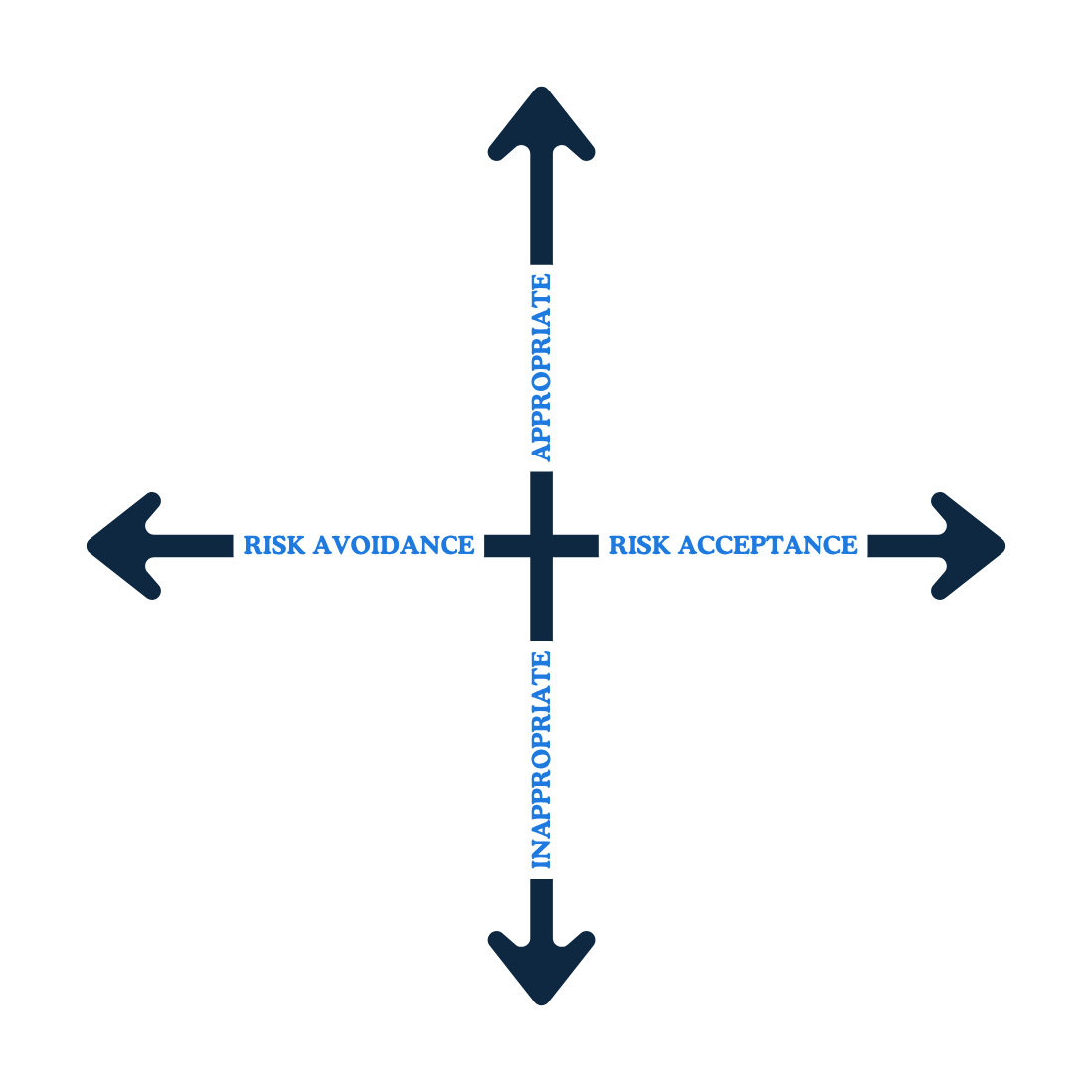
The Risk Response Matrix showing risk avoidance and risk acceptance on the horizontal axis, and appropriate and inappropriate responses on the vertical axis.

In John 7-11, Jesus repeatedly faces danger, opposition, uncertainty, and opportunity. Sometimes He withdraws. Sometimes He advances. Sometimes He delays. Sometimes He acts publicly. Sometimes He remains hidden. Yet throughout these changing circumstances, His mission remained fixed: to accomplish the Father's will, reveal His identity, and glorify God. His tactics remained flexible.

Likewise, our goal is not to permanently occupy one side of the matrix. Healthy leaders learn to move appropriately between risk acceptance and risk avoidance as circumstances change. The upper half of the matrix forms the healthy operating zone for kingdom leadership.

The Risk Response Matrix reflects these biblical patterns and provides a systematic approach to risk management. It helps leaders discern when courage is required and when restraint is wise, evaluating not only whether they are avoiding or accepting risk, but whether their response is appropriate to the mission and moment.
This is how Jesus moved within the healthy operating zone and avoided inappropriate risk responses.

Quadrant 3: Appropriate Risk Avoidance

Jesus delayed travel, attended the festival discreetly, escaped hostile situations, and withdrew when opposition intensified. None of these actions represented fear or compromise. They protected the mission until the appropriate moment arrived.

Quadrant 1: Appropriate Risk Acceptance

Jesus demonstrated this when He openly proclaimed His identity and returned to Judea despite the disciples' concerns about recent threats. He evaluated risk in light of God's purpose rather than personal safety. The opportunity aligned with the Father's timing and therefore required action.

Quadrant 4: Inappropriate Risk Avoidance

The disciples hesitated when Jesus proposed returning to Judea. Their concern was understandable, but excessive caution can become a barrier to obedience. Sometimes the greatest risk is failing to act when God opens a door.

Quadrant 2: Inappropriate Risk Acceptance

Jesus repeatedly resisted pressure to act publicly before the appropriate time. He never interpreted divine protection as permission for careless behavior. Courage without discernment quickly becomes recklessness.

Conclusion

Discernment, not a permanent posture

Jesus continually moved between appropriate risk acceptance and appropriate risk avoidance - the healthy operating zone - while remaining perfectly aligned with His mission and helping others do the same. The challenge for kingdom leaders is to do likewise: holding firmly to God's calling while remaining flexible in the tactics required to fulfill it.

The purpose of the Risk Response Matrix is not to help people become more cautious or more courageous. Its purpose is to cultivate discernment. In our training you can dig deeper and apply this tool to your risk management.

Explore Training options